Showing posts with label weather. Show all posts

Thursday, March 1, 2012

Du Vin Chaud

One thing that Europeans do very well is Christmas Markets. Montpellier was no exception, however not on the level of those found in and around Berlin or some of the other locations I visited. This post is long overdue (as I speak, it's 20 degrees celsius/70 degrees fahrenheit, and the first of March), but that's what you get when you're off doing other things.

Our Christmas market was based in La  Place de la Comédie. Being the South of France, it still wasn't that cold here in Montpellier, so they simulated coldness by using white and blue coloured lighting (they needed to wait until early February for the two-week spell of Siberian temperatures!).


For several weeks, the thing to do around here was to meet up with friends, drink mulled wine (vin chaud) and wander around the market . . . snacking on all of the wonderful food options and running into other people in and about the temporary log cabins set up in the square.


Monday, April 25, 2011

On Location: Out of Africa

The same day as we went to Hell's Canyon, we headed onwards to Lake Naivasha. Lake Naivasha is freshwater, and has hippos (you can just see the top of one and its ears in the third photo below)!!! This area is part of the Great Rift Valley in Africa, too.

 We drove to the lake, and took a boat across to Crescent Island. Crescent Island is where the film Out of Africa was shot. Originally, most of the animals you can see on the island did not live there. They were brought in for the filming, so that the film crew could be safe from the predatory/dangerous animals in the Great Rift Valley, yet still film shots of the gazelles, impala, water buck, water buffalo, antelopes, giraffes, zebra, warthog, and more.  As far as I understand it, the only cat that has been brought into this ecosystem is the spotted hyena. After filming, the animals were left there, and it has since become a flourishing reserve.

 As with the previous biking trip, this was walking--very rare in a safari experience, as it is usually too dangerous. It was amazing to wander around the island and be so close to the animals. One of my favourites were the giraffes. There was a baby giraffe that was just 10 days old (not that you'd know it), and I enjoyed watching the tower of giraffes (who knew a group of giraffes was called a "tower") amble around, eating from the beautiful yellow acacia trees.
A surprise find was a python. In fact, we saw three of them--baby Rock Pythons in a burrow. These snakes get to be 6 meters (20 feet) long. Our guide told us that they don't bother humans much, but wikipedia tells me that they are "opportunistic feeders, and will consume almost any animal that they come across and can overpower by constriction . . . adults are capable of taking very large prey, including young crocodiles, goats, gazelles, warthogs, and even humans, making them potentially very dangerous." I'm glad we didn't see the mother!
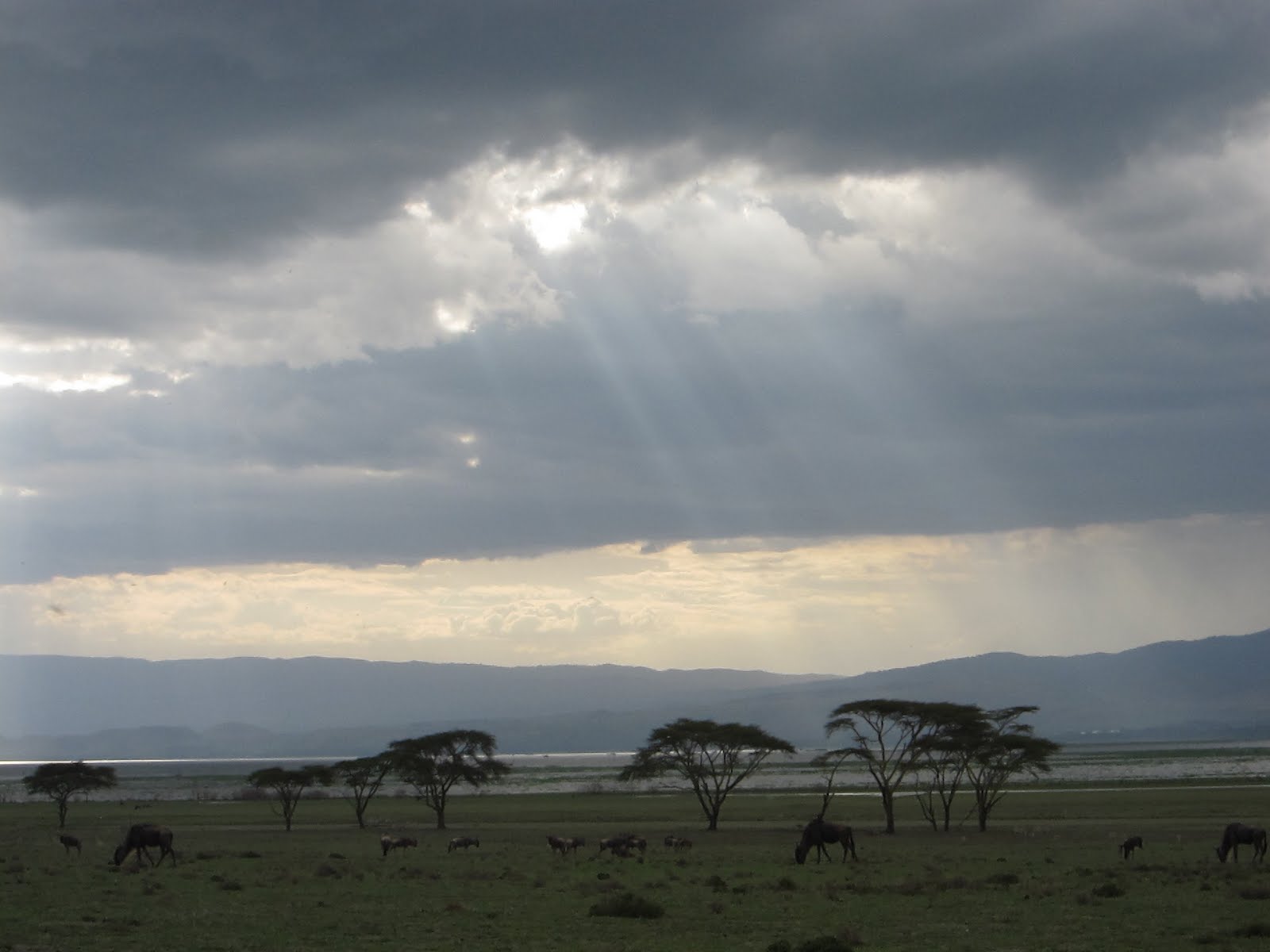
In addition to the animals, as the sun started to set, a beautiful combination of clouds, late afternoon sun and a view of rain that hadn't quite hit us, conspired to create a beautiful backdrop for the landscapes.


 The experience was just breathtaking, and my photographs don't do it justice. My camera is just a point and shoot, as I have been attempting to keep my pack weight down to less than 11 kg. If I were to go again to East Africa, or another wildlife-focused location, I think I might have to splurge on a camera with a decent zoom. However, the memories are more important, and it was a perfect day.

Saturday, January 29, 2011

Climate Lesson

Dunedin is on the East Coast of the South Island of New Zealand. It is classified as temperate, and might be considered similar to San Francisco. Weather is very changeable (remember this adjective if you ever visit and are considering what to pack); you can often have four seasons in one day.

Dunedin climate, historical averages.

Temperature, celsius Jan Feb Mar Apr May Jun Jul Aug Sep Oct Nov Dec Average
Previous Averages 14.7 14.7 13.4 10.7 7.6 4.9 4.8 6.5 8.6 10.5 11.9 13.8 10.2
Rainfall, millimeters  Jan  Feb Mar Apr May Jun Jul Aug Sep  Oct Nov Dec Average
Previous Averages 70 41 61 54 59 48 45 50 47 57 57 70 55
Wind Run, kms           Jan Feb Mar Apr May Jun Jul Aug Sep Oct Nov Dec Average
Previous Averages 168 156 156 144 156 132 132 144 168 180 180 168 157
Sunshine, hours         Jan Feb Mar Apr May Jun Jul Aug Sep Oct Nov Dec Average
Previous Averages 174 165 143 128 99 98 100 122 134 162 169 182
 * 1749 to 2003 (http://www.climate.co.nz/)

The hills that surround the city mean that the lowland town area is often more sheltered, whereas up here on Pine Hill, or Mt. Cargill it can get pretty windy. With our hills and valleys you can get anabatic and katabatic winds. Mt Cargill can trap the rain coming in from the Southeast, and leave the other side completely sunny in the Mt's rain shadow. This results in the roadtrip effect . . . whereby as people return from holiday in central otago or further up the coast, and come over the hill into Dunedin, inexplicably it starts to rain :)

The average yearly rainfall is 660mm, but feels like more because it tends to arrive as a mist/drizzle that persists. Of the main centers in NZ, Dunedin is the coolest, as it's found the furthest South.

Read the Dunedin City Council's Report on Dunedin and Climate Change by University of Otago Emeritus Professor of Geography Professor Blair Fitzharris. Dunedin may be one city that superficially benefits from a temperature increase--but what's going to happen to Logan Park and all that reclaimed land down by the harbour?

In the meantime, here's the view from my parents' house on a typical day :) Mist, rain, rainbows (out of my chosen window/view), cloud, sun, wind. No hail or snow as yet, but it is supposedly summer. Photos probably aren't in order.