
Well, as it's the best holiday ever invented (in its current evolutionary phase--I entirely agree with anyone who wants to talk about indigenous rights), I wanted to spend Thanksgiving amongst friends. Tell me if you can think of anything bad about feeling thankful, cooking, eating, drinking, friends, family, singing, games, more eating, and napping. Impossible. So with that in mind, I decided to hop the ditch and spend my thanksgiving (yes, I know this blog is hopelessly out of date) with Sarah Galbraith and contingent. Unfortunately the trip was incredibly short, so I decided to make it simple and not try to catch up with all of the other lovely people in London--that will have to wait until May/June when I return next.
 On arrival, I couldn't help but sing The Wombles on the train.

And then we were off for my first London pub--and some snooker playing amongst the hippest of hipsters. Wow, there were some great woolen jerseys in that dive.
The next 24 hours were full of Thanksgiving goodness. Markets for fresh ingredients, cooking, organizing the apartment to fit more people than it should . . .


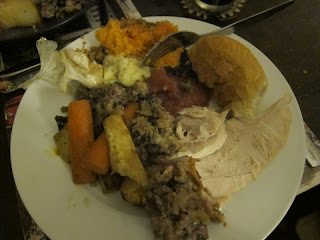
The meal itself was amazing. Turkey, two types of stuffing (one with haggis), mashed potatoes, cranberry sauce, apple/blueberry sauce, numerous roast vegetables, various salads, pies and cakes galore. The English contingent pulled out all of the stops.


The night continued on into singing and music and laughter, until I fell asleep somewhat mid-sentence. Standard.
The next day was absolutely beautiful and sunny, and we went riding our bikes all over, ending up at Derek and Laura's place for pancakes and blueberries. It was awesome to meet Achilles Renoir--what a cool wee man. We also went for a wander in Hampstead Heath, catching up on the last few years of events, and kicking leaves. Unfortunately, I left my camera at home, so you'll have to take me at my word. It was a picture-perfect endorsement for moving to London--hmmm.
My last full day in London was spent attempting to fit in a variety of tourist-centered attractions in a haphazardly browsing fashion. I started out with my atlas and compass in hand, and headed for the South bank of the Thames. I tracked down a Banksy . . . covered in plexiglass it gives food for thought--is this how street art should be treated? On the one hand, it's worth a ton of money intact, and as is can be protected from further tagging and artworks. On the other, the nature of street art is ephemeral and often politically or socially motivated and pertinent to a moment in time, rather than preservation through the ages. Thoughts?

I also saw a series of these characters . . . which I thought were incredibly emotive, encircling a worksite. Looked like they were possibly commissioned.

I then trolled the bridges . . . Tower, London, Southwark, Millenium (which looks fabulously like a spine), Blackfriars, and Waterloo.


I spent several hours at the Tate Modern. As usual, dreaming of all the artworks and projects I could do.

In wandering about London, I was intrigued and excited by the juxtaposition and layering of different epochs and styles of architecture and art. What an interesting city.


With the light fading, I suddenly realised that my version of hitting the tourist spots didn't really fulfill the norm, and that I'd at least like to catch a glimpse of some of the more famous landmarks, so I speed-walked my way about, getting in the new Globe Theatre, Big Ben, The Houses of Parliament, Westminster Abbey, Buckingham Palace and its famous guards, Trafalgar Square, a double-decker, a red telephone box, and a heartbeat's worth of the British Museum (which only fueled fire to my desire to return). . . all in just a few hours of severe ADHD.


And then I returned to the real-world, the London I was there to see . . . spending another lovely evening with Sarah and Brendan.

In the morning, we frequented the local tea shop--I promise I'll always remember to let you have the front section of the paper first, Brendan. I cede it to you for all eternity. Look at that look he's giving me--it's just daring me to try for it. Also, the perspective in this shot is a *little* off, but yes, he is an extremely tall, lovable Scotsman, and Sarah is quite the compact model.

Thank you all for a lovely time. And you entirely succeeded in making me think very very seriously about London as a next sedentary location for this wandering minstrel.
Oh the decisions to be made . . .


And then we were off for my first London pub--and some snooker playing amongst the hippest of hipsters. Wow, there were some great woolen jerseys in that dive.
The next 24 hours were full of Thanksgiving goodness. Markets for fresh ingredients, cooking, organizing the apartment to fit more people than it should . . .


The meal itself was amazing. Turkey, two types of stuffing (one with haggis), mashed potatoes, cranberry sauce, apple/blueberry sauce, numerous roast vegetables, various salads, pies and cakes galore. The English contingent pulled out all of the stops.


The night continued on into singing and music and laughter, until I fell asleep somewhat mid-sentence. Standard.
The next day was absolutely beautiful and sunny, and we went riding our bikes all over, ending up at Derek and Laura's place for pancakes and blueberries. It was awesome to meet Achilles Renoir--what a cool wee man. We also went for a wander in Hampstead Heath, catching up on the last few years of events, and kicking leaves. Unfortunately, I left my camera at home, so you'll have to take me at my word. It was a picture-perfect endorsement for moving to London--hmmm.
My last full day in London was spent attempting to fit in a variety of tourist-centered attractions in a haphazardly browsing fashion. I started out with my atlas and compass in hand, and headed for the South bank of the Thames. I tracked down a Banksy . . . covered in plexiglass it gives food for thought--is this how street art should be treated? On the one hand, it's worth a ton of money intact, and as is can be protected from further tagging and artworks. On the other, the nature of street art is ephemeral and often politically or socially motivated and pertinent to a moment in time, rather than preservation through the ages. Thoughts?

I also saw a series of these characters . . . which I thought were incredibly emotive, encircling a worksite. Looked like they were possibly commissioned.

I then trolled the bridges . . . Tower, London, Southwark, Millenium (which looks fabulously like a spine), Blackfriars, and Waterloo.


I spent several hours at the Tate Modern. As usual, dreaming of all the artworks and projects I could do.

In wandering about London, I was intrigued and excited by the juxtaposition and layering of different epochs and styles of architecture and art. What an interesting city.


With the light fading, I suddenly realised that my version of hitting the tourist spots didn't really fulfill the norm, and that I'd at least like to catch a glimpse of some of the more famous landmarks, so I speed-walked my way about, getting in the new Globe Theatre, Big Ben, The Houses of Parliament, Westminster Abbey, Buckingham Palace and its famous guards, Trafalgar Square, a double-decker, a red telephone box, and a heartbeat's worth of the British Museum (which only fueled fire to my desire to return). . . all in just a few hours of severe ADHD.


And then I returned to the real-world, the London I was there to see . . . spending another lovely evening with Sarah and Brendan.

In the morning, we frequented the local tea shop--I promise I'll always remember to let you have the front section of the paper first, Brendan. I cede it to you for all eternity. Look at that look he's giving me--it's just daring me to try for it. Also, the perspective in this shot is a *little* off, but yes, he is an extremely tall, lovable Scotsman, and Sarah is quite the compact model.

Thank you all for a lovely time. And you entirely succeeded in making me think very very seriously about London as a next sedentary location for this wandering minstrel.
Oh the decisions to be made . . .


